



Is a Deep Cleaning a Scam? An Honest Answer From a Biological Dentist
Unfortunately, it can be.
I saw a post on Facebook recently where someone called deep cleaning a scam. The comments were full of people sharing stories. Some felt pressured into treatment they didn’t understand. Others said deep cleaning saved their teeth.
Here is the honest answer, and it may surprise you coming from a dentist.
It can be both.
Deep cleaning is not a scam when there is clear evidence of gum disease, transparent communication, and a real plan to help you heal. It feels like a scam when it is sold without data, context, or respect for your understanding.
Let’s unpack both sides.
What a deep cleaning actually is
A deep cleaning, also called scaling and root planing or SRP, removes plaque, tartar, and bacterial buildup from below the gumline, then smooths the root surfaces so bacteria have fewer places to hide.
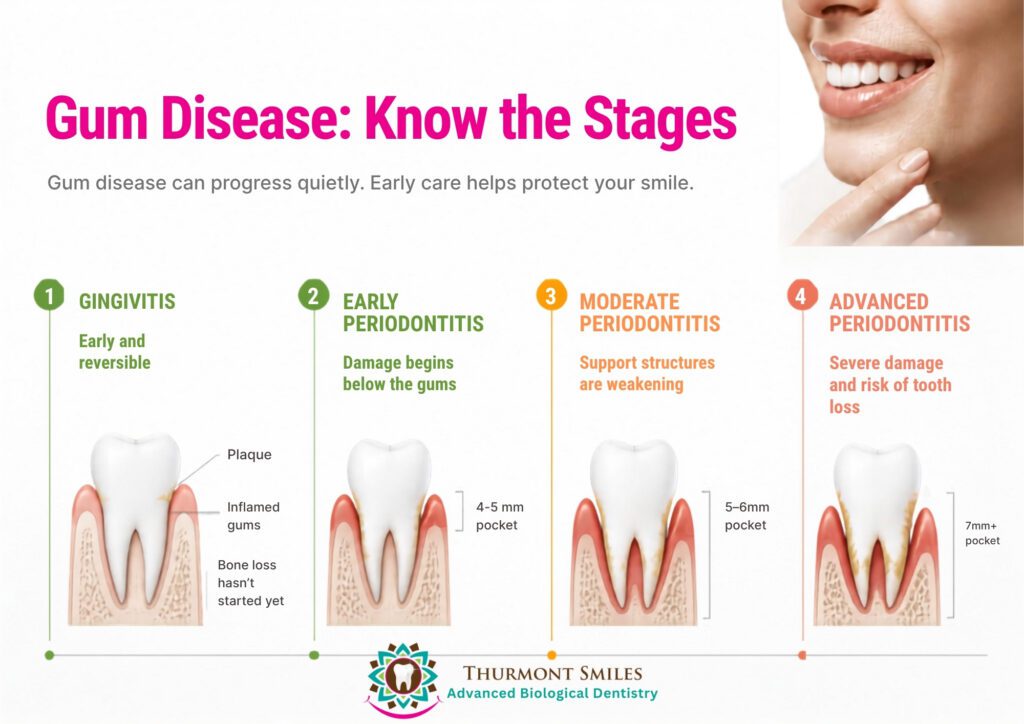
That is what makes it different from a regular cleaning, which works above and just at the gumline. A deep cleaning treats periodontal pockets, the deepened spaces between tooth and gum that form when inflammation and bone loss are present.
The disease it treats is real. Gum disease is a chronic hidden infection. It starts as gingivitis, and if it progresses to periodontitis, it destroys the bone holding your teeth in place. The same bacteria and inflammation are linked to heart disease, blood sugar problems, and other conditions throughout the body.
So we are not just scraping teeth. We are interrupting a chronic inflammatory process that affects your whole body.
The story that made me write this
A young woman came to us for a second opinion. She had been told she needed a full deep cleaning, all four quadrants of her mouth. When we did her exam, the numbers told a different story.
Her home care was impeccable. She deeply cared for her teeth and her mouth health, and she knew the connection of her mouth to the rest of her body. Just by looking at her gums, even without measuring, I could tell her mouth health was exceptional. I did the gum measurements anyway, because they are part of our full wellness checkup. She did not have a single bleeding point. All of her gum numbers were completely normal. She had no tartar on her teeth, no cavities, and barely any plaque. She absolutely did not need scaling and root planing.
If she understood the treatment recommendation from the previous provider correctly, then unfortunately, she was probably a sales target.
That patient had every right to feel skeptical. And that skepticism is exactly why you should know how this diagnosis is actually made.
When a deep cleaning is absolutely not a scam
Deep cleaning is appropriate, and necessary, when the evidence is there:
True periodontal pockets. Your hygienist measures the space between your gums and teeth with a small probe, in millimeters, at six points around every tooth. Healthy pockets measure 1 to 3 millimeters. Pockets of 4 to 5 millimeters or deeper, especially with bleeding, are areas your toothbrush and floss cannot reach. You should hear these numbers called out during your exam, and you can ask to see them.
Bleeding and inflamed gums. Healthy gums do not bleed during a gentle exam. Swollen, tender, or bleeding gums are early signs of infection.
Bone loss on your X-rays. Gum disease destroys bone. Your X-rays should show whether that has actually happened, and someone should point it out to you.
Bacterial evidence. In our practice we regularly run salivary testing that identifies the exact bacteria in your mouth and how aggressive they are. This takes the diagnosis from “your gums look inflamed” to “here are the specific pathogens we are treating.” Not every office does this, but it is the level of certainty I believe patients deserve.
Systemic risk factors. If you have diabetes, heart concerns, or other inflammatory conditions, an active gum infection matters even more, because your mouth and body share the same bloodstream.
When these signs are present, a regular cleaning is simply not enough. The infection is below the gumline, out of reach.
When it feels like a scam
The treatment itself is rarely the problem. The way it is presented often is. Deep cleaning feels suspicious when:
- No one shows you the evidence. No pocket measurements, no X-rays, no photos. Just “you need four quadrants of deep cleaning.”
- Everything suddenly became severe. You went from “no one ever said anything” to “you urgently need thousands of dollars of treatment” with no explanation of what changed.
- The conversation is about insurance codes, not your health. When coverage drives the recommendation instead of your actual condition, something is off.
- There is no talk of home care or root causes. If the whole plan is a procedure with no discussion of your habits, your nutrition, or why the infection took hold, it feels like a sale, not healthcare.
When that happens, patients feel pressured instead of empowered. That is where the “scam” feeling comes from, and honestly, I understand it.
Ask yourself these questions too
Diagnosis is a two-way conversation. Be honest with yourself:
- Have I actually kept my teeth and gums impeccably clean at home?
- Have I kept up with my regular cleanings and checkups, or has it been a few years?
- Did my previous office measure my gums every year? If they did, there is a record. Your numbers over time tell the real story.
If you have missed years of care, deeper pockets are not a surprise or a sales tactic. They are what happens when bacteria have time to work undisturbed.
How we approach it differently
In biological dentistry, periodontal therapy is about whole-body healing, not just cleaning deeper. In our practice that means:
- Reducing the bacterial load first. We use ozonated water irrigation and laser therapy to lower harmful bacteria in the pockets before and during scaling, which also means less bacterial spillover into the bloodstream during the procedure.
- Working with your body, not against it. Biocompatible materials and gentle antibacterial support that respect your oral microbiome.
- Rebuilding a healthy microbiome. The goal is not just to scrape away tartar but to disrupt the harmful biofilm and help healthier bacteria take its place.
- Looking for the root cause. Nutrition, immune health, airway, habits, and salivary DNA testing to identify high-risk pathogens and personalize your treatment.
Done this way, a deep cleaning is one piece of a complete oral and whole-body health plan, not a standalone product.
Know the real cost of doing nothing
If you truly have gum disease and skip treatment, here is what that decision costs over time: continued bone loss, loose teeth, extractions, and eventually implants or dentures that cost far more than the treatment you avoided. And that is only the dental side. The inflammatory burden on the rest of your body is the part most people never connect to their mouth.
This is not about scaring you into treatment. It is about making the decision with full information instead of a Facebook comment thread.
What good treatment looks like
A deep cleaning done well is not a one-time transaction. It should look like this:
- Measurements before. You see your numbers and understand them.
- Treatment with a clear explanation. You know which areas are being treated and why.
- Re-evaluation after. Four to six weeks later, your gums are measured again. Good treatment shows up in the numbers. Pockets get shallower. Bleeding stops.
- A maintenance plan. Gum disease is managed, not cured. After treatment, most patients need cleanings every three to four months, not every six, because the bacteria repopulate on that timeline.
- Better home care, taught, not assumed. You leave knowing exactly what to do at home so the infection does not simply come back.
If your treatment was never measured before and after, you have no way to know if it worked. That, more than the treatment itself, is what deserves your skepticism.
The bottom line
Deep cleaning is not a scam. Overdiagnosis and poor communication are. The difference is evidence, and you have every right to see it before you decide.
If you have been told you need a deep cleaning and something feels off, get a second opinion with full measurements and testing. Your gut feeling deserves data, one way or the other.
Dr. Mansi Oza, BDS, DMD, FICOI
Thurmont Smiles | 301-271-4400